Building the Great Society: Inside Lyndon Johnson's White House by Joshua Zeitz
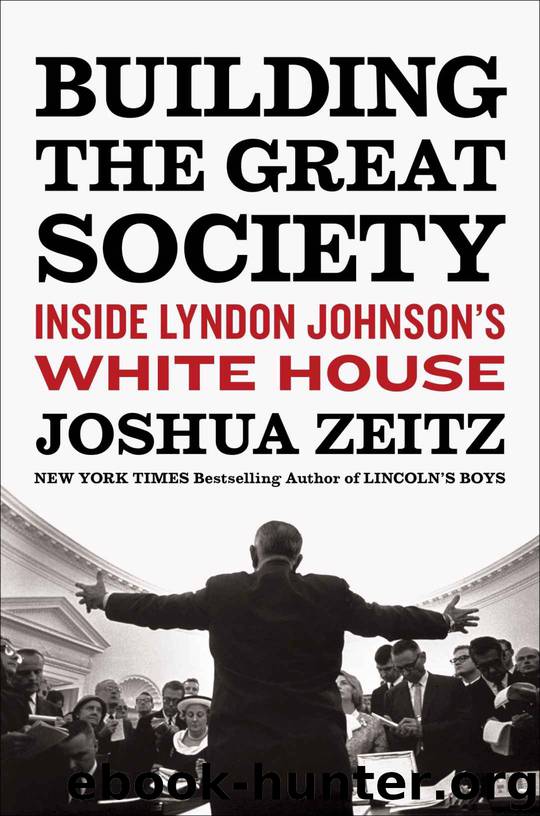
Author:Joshua Zeitz [Zeitz, Joshua]
Language: eng
Format: azw3, epub
Publisher: Penguin Publishing Group
Published: 2018-01-30T05:00:00+00:00
* * *
• • • • •
The “Fabulous Eighty-ninth” began its work against a dramatic backdrop. By early 1965, Martin Luther King Jr. had already determined to stage his next campaign in Selma—the seat of Dallas County, Alabama, where black residents made up over half the population but only about 2 percent of registered voters. King’s strategy was at once simple and complicated. Since Congress passed the Civil Rights Act six month earlier, the movement had renewed its focus on voting rights—a giant piece of the civil rights puzzle that still required legislative remedy. From a numbers perspective, the decision made sense. As King explained to readers of the New York Times, “Selma has succeeded in limiting Negro registration to the snail’s pace of about 145 persons a year. At this rate, it would take 103 years to register the 15,000 eligible Negro voters of Dallas County.”
Most liberals understood that securing access to the ballot box necessarily constituted an important part of the Great Society. In a phone conversation with King on January 15, LBJ named voting rights as a centerpiece of the civil rights agenda but signaled his intent to wait until Congress passed his health-care and education packages before introducing legislation. He was confident in his strategy and counseled King to galvanize support by “find[ing] the worst condition that you run into in Alabama, Mississippi, or Louisiana, or South Carolina. . . . And if you just take that one illustration and get it on radio and get it on television and get it in the pulpits, get it in the meetings, get it every place you can . . . then that will help us on what we’re going to shove through in the end.” Unbeknownst to LBJ, King had already found his “one illustration”: Selma, Alabama.
King’s own notes explained his thinking: (1) “nonviolent demonstrators go into the streets to exercise their constitutional rights”; (2) “racists resist by unleashing violence against them”; (3) “Americans of conscience in the name of decency demand federal intervention and legislation”; (4) “the Administration, under mass pressure, initiates measures of immediate intervention and remedial legislation.” Selma was a hornet’s nest of racial violence. The Student Nonviolent Coordinating Committee had been active there since 1962, but now King’s Southern Christian Leadership Conference planned to join the fray and “dramatize the situation to arouse the federal government by marching by the thousands to the places of registration.”
True to form, local authorities under Dallas County’s sheriff, Jim Clark, took the bait. They clapped over two thousand activists in jail in the first weeks of the campaign and rained unspeakable violence on peaceful protesters. On February 18, state troopers beat and shot Jimmie Lee Jackson, a twenty-six-year-old voting rights demonstrator. When Jackson died eight days later of his wounds, movement leaders conceived a fifty-mile march from Albany to Montgomery, where they would voice their grievances on the steps of the state capitol. The campaign’s climactic moment occurred on Bloody Sunday—March 7, 1965—when state and county law
Download
Building the Great Society: Inside Lyndon Johnson's White House by Joshua Zeitz.epub
This site does not store any files on its server. We only index and link to content provided by other sites. Please contact the content providers to delete copyright contents if any and email us, we'll remove relevant links or contents immediately.
| Anthropology | Archaeology |
| Philosophy | Politics & Government |
| Social Sciences | Sociology |
| Women's Studies |
The Secret History by Donna Tartt(19121)
The Social Justice Warrior Handbook by Lisa De Pasquale(12198)
Thirteen Reasons Why by Jay Asher(8925)
This Is How You Lose Her by Junot Diaz(6899)
Weapons of Math Destruction by Cathy O'Neil(6288)
Zero to One by Peter Thiel(5810)
Beartown by Fredrik Backman(5772)
The Myth of the Strong Leader by Archie Brown(5515)
The Fire Next Time by James Baldwin(5458)
How Democracies Die by Steven Levitsky & Daniel Ziblatt(5226)
Promise Me, Dad by Joe Biden(5160)
Stone's Rules by Roger Stone(5092)
A Higher Loyalty: Truth, Lies, and Leadership by James Comey(4971)
100 Deadly Skills by Clint Emerson(4936)
Rise and Kill First by Ronen Bergman(4803)
Secrecy World by Jake Bernstein(4758)
The David Icke Guide to the Global Conspiracy (and how to end it) by David Icke(4725)
The Farm by Tom Rob Smith(4518)
The Doomsday Machine by Daniel Ellsberg(4495)
